

Pound Cake and its Compotes
On the value of working within limits.

My husband Michael’s Manchego-based au gratin potatoes won the Easter brunch table last week; golden-edged slices stacked in a casserole, bubbling in a slightly tangy cream. His win is no surprise, if you have ever had his cooking. The rest of us jostle for second-place, no matter whether we make or buy. His aromatic offering sat alongside a locally-smoked ham brought by his brother, along with some profoundly fluffy rolls from a local scratch bakery. Myself, I made and brought a not-so-shabby broccoli & bacon salad, from a recipe Michael selected. Because there had to be something green and crunchy on the table.
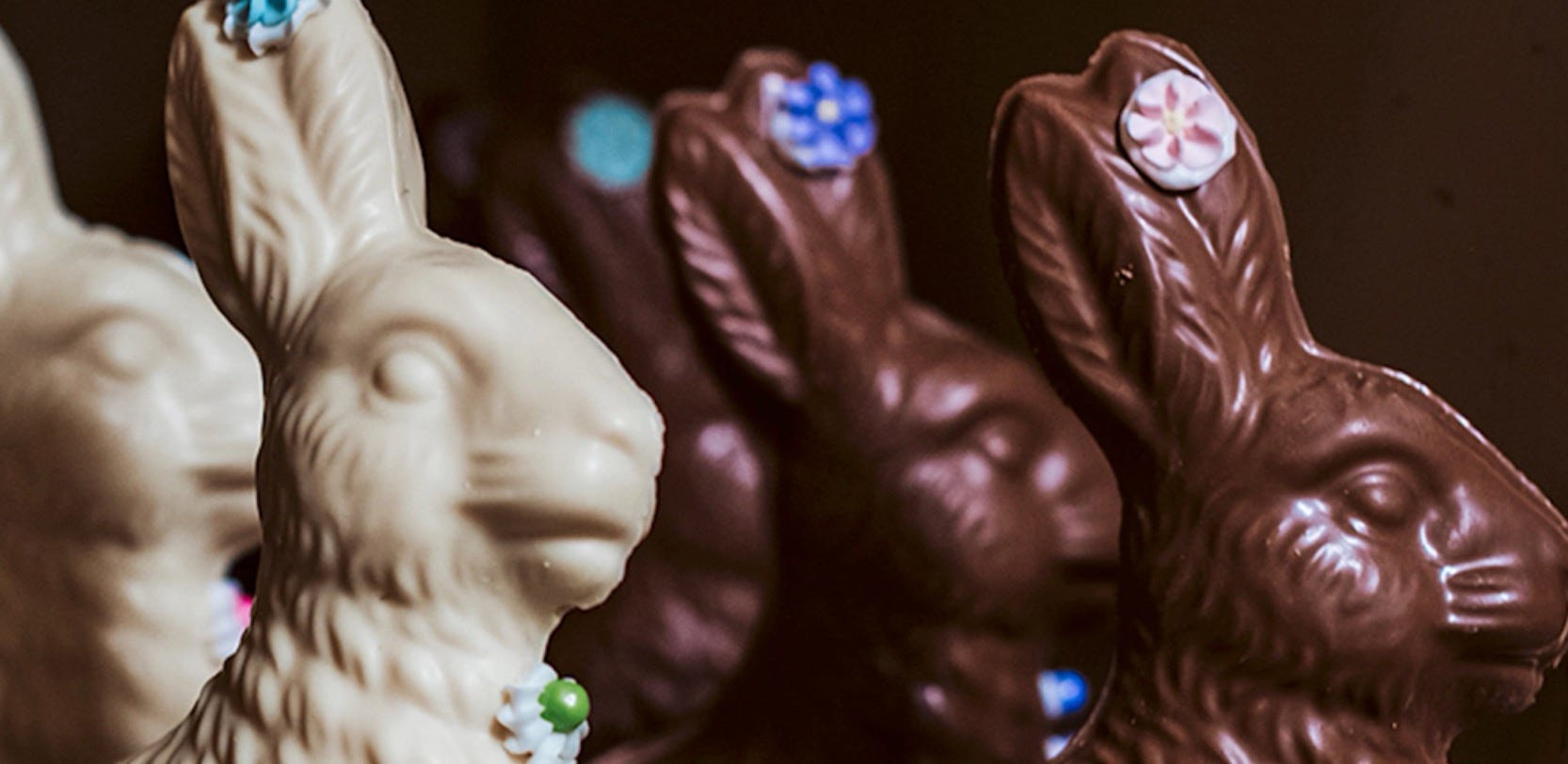
Two varieties of deviled eggs were on display, next to a similar count of relish trays, with radish rosettes and pickles pulled from cool basement jars. We also enjoyed homemade pickled beets, a clove-scented delicacy I learned to love from my dad. Cousin Candy brought a big selection of chocolates, nougats, and multi-colored sugar-wafers from Helena’s 104 year old Parrot Confectionary, because, as amazing as her cooking was, back in the day, and it was, Candy gets a pass, now, thanks to her double-tank oxygen supply.
By the time my single-tank mother-in-law, Jeanette, brought out Elvis Presley’s Favorite Poundcake for dessert—complete with your choice of homemade Huckleberry and/or Strawberry compote ladled off-side or over the top—my appetite was nearly in rebellion. Once Elvis was finished with me, I could not eat one … more … bite.
So, I went for a walk. It had been months since I had chatted with Ross, a dear friend, who long helped anchor Portland’s fringe theater scene, as well as stock its weirdest vintage shops, using his eye for worn-classic beauty.
Ross has always nurtured my creative pursuits. This time, he invited me to write about limits. He waxed a bit about “having enough,” in a culture of excess. I avoided thinking about his age, which not quite recently drove past 80. He pondered what it means to pay attention to your belt, or any belt, for that matter, well enough to notice the moment when it goes uncomfortably tight. The irony of which was not lost on me, given I had just pressed pause on the Easter brunch above.
I expect anyone reading this has their own take on what too much can mean. Just having a screen on which to read a Substack article means having access to endless scrolling feeds of whatever we have told the algorithms we like most.

Which is a well-known trope.
What feels less known, to me, is how to navigate based on a sensation of sufficiency. How to say no, without gimmicks or convincing. Not the no of a GLP-1 drug, nor the no of software locking me out of my phone for a while each day. But, the no found on a paint-palette, where an artist has said yes to a chosen set of hues, and what may be done with them.
This notion of limited palettes has floated through conversations with another dear friend, Derek. He works in the software gaming industry. He tells me that when new games are designed, there is a known tension as to how many options to provide. Too many choices, offered too quickly, and many players will be too overwhelmed to bother. They will switch away or keep scrolling. Too few choices, though, and they get bored, and move on. Repetitive flows of simple choices seem to be the baseline drug of choice, as in Candy Crush (or Instagram). Different players also have different appetites, tastes, and capacities, making digital game design a complex process.
And, centuries later, chess remains pretty much the world’s most popular game, with its six types of game piece, arrayed on an 8 by 8 checkerboard.
Early in my software career, I came across “CatB,” which is shorthand for one of the most famous essays in the history of tech: The Cathedral and the Bazaar, by Eric S. Raymond.1 This essay-turned-book teaches many things. I have long held onto one specific takeaway: there are tools, and there are solutions.
A tool is a device to perform a well-defined task. A tool does what it does, and no more. A human can learn a set of tools, and apply them in repetition or sequence, as needed, to solve an endless array of problems.
On the other hand, a set of tools can be pre-selected, sequenced, packaged, and automated to define one approach to an overall process, which is then sold as a (“the”) comprehensive solution to a set of interrelated problems. A set which the makers have defined for you in advance, generally without asking.
Tools keep humans in the middle of a process, requiring us to struggle a bit, at first, as we build our skills, and find our own efficiencies. Solutions, on the other hand, set humans and our struggles off to the side, by selecting a set of problems and defining a problem-solving process. A process which does what its makers designed it to do with their “problem space,” and no more, yet with speed and efficiency. The human is just there to feed it problems.
AI is now poised to become the final solution, for processing humans, by choosing which inefficiencies it finds to be a problem.
I wasn’t sure which compote I wanted on my pound cake. Huckleberry is the Montana classic. Strawberry, though, takes me back to Sunday after-church breakfasts when I was a kid, which were often the best meal of the week.
Michael solved this problem by artfully dropping a spoonful of each on either side of a yellow slice standing in the center of his plate. Myself, I tipped my slice flat and chose my childhood, ladeling on two silky spoonfuls of strawberry, and watching them slide down my own golden wedge.
Two problems, two tools, two solutions, both uniquely delicious.
The Cathedral and the Bazaar, Eric S. Raymond (2000).
https://creatingaction.stanford.edu/pdf/cathedral-bazaar.pdf