

Politics as if Other States Matter
Lazy Democratic messaging lets their party fringe define them. And us.

Preface: I began writing this article about one week ago. Oregon Initiative Petition 28 (IP28) began circulating for signatures two years ago. In May, 2026, the “Yes” campaign submitted more than enough signatures to qualify for the ballot. Over just the past days, as of this article, the Oregon House Democratic Caucus and Governor Tina Kotek finally issued statements opposing it.
I am choosing to run this article anyhow, with this added preface, because its core meaning remains: Democrats in states that allow ballot measures1 need to be far more responsive when extremist ballot measures circulate in their state, because they get hung around far more necks than just their own.
Update: On July 24, 2026, the Oregon Secretary of State determined IP28 failed to gain sufficient valid signatures to qualify to appear on the 2026 ballot.
Back in the oughties, I served for three years on the Executive and Central Committees of the Democratic Party of Oregon (DPO), as Chair of its Platform and Resolutions Committee. During those years, I learned first-hand how elected officials, and party officials, will say what they please, even if the party has taken a different stance, whether by resolution or by a platform plank. These same officials will also remain silent, if they please, blaming the party for not having yet “spoken” on a topic, again whether by resolution or platform plank.
Said differently, party officials say what they please, regardless of what their party activists may resolve. Party platforms and resolutions exist to provide foils or fig leaves, as any party official may need, while keeping the activists who draft them busy, believing they are doing something relevant.
Shortly before I woke up to this, and resigned, I watched the Chair of the DPO chuck her hand-delivered copy of the 2010 DPO Platform—the final work product of that election year’s platform convention, representing thousands of hours of collective effort, by delegates from across the state—into the remote bowels of her desk, to deliver the clear message that she could not care less what it said.
I got into a bit of a dustup on Facebook last week.
IP28—which 131,220 Oregonians have signed, so far, will be on Oregon’s November ballot. If passed, it will criminalize fishing, hunting, rodent trapping, and livestock herding. It would extinguish Oregon’s support for ancient Tribal fishing rights. It would exterminate significant parts of Oregon’s outdoor recreation industry, and wipe out dairy farms (bye-bye Tillamook Cheese?) It could shut down the Oregon Zoo. IP28 exists to criminalize treating any animal differently than a well-kept household cat2.
Several friends in Portland seemed incensed that I expect elected Democrats in Oregon, including the leaders of Democratic Party of Oregon (DPO) itself, to speak out against IP28. Loudly, and promptly.
One friend repeatedly insisted that elected Democrats cannot be expected to say anything about IP28, because they are not allowed to, until the DPO Central Committee has issued a resolution on the topic at a quarterly meeting.
I rolled my eyes.
Said sarcastically, IP28 is an attempt to write “The Vegan Agenda” into law.
Said more bluntly, IP28 is a blatant effort to force narrow cultural values onto the general public, just like the infamous 90s-era Oregon Citizens Alliance ballot measures3 tried to write narrow religious hatred for homosexuals into the law.
Historically, Montana is a purple state. For decades, the legislature and statewide offices were swapped between the parties. Then, in the 2022 and 2024 elections, the Montana Republican Party began posting billboards reading “Don’t Want Montana to Become Portland? Vote Republican.” The state turned bright red.
Just this month, Montana’s right-wing Christian Nationalist Governor, Greg Gianforte, has begun running ads mocking “Democrats” for Oregon’s IP28 (“They are literally trying to outlaw hunting”)—even though he’s not even up for re-relection. And, even though IP28 is happening over in Oregon, not Montana.
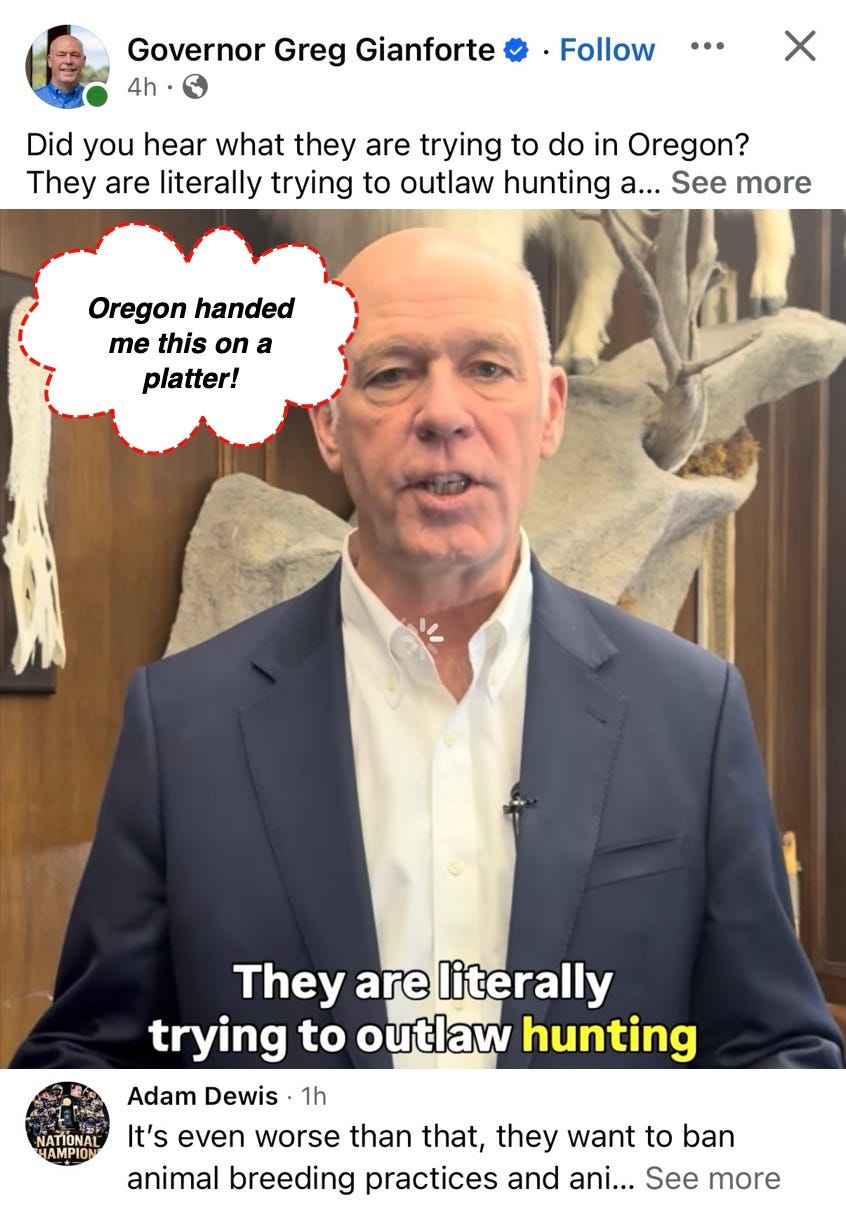
It is a very effective message, outside of Portlandia.
To a far greater degree than my many friends in Oregon realize, “Portland, Oregon” has become a national code-word for radical left-wing extremism.
Which is problematic, because Oregon’s nearby rural Western states—Idaho, Montana, Wyoming, and the Dakotas—have 10 total Senators, compared to just 6 for the whole Left Coast—California, Oregon, and Washington.
Yet, those 10 rural Senators, now all Republican, are elected by just 5.5 million people, compared to the 55 million mostly-urbanites, who elect the Left Coast Six. Greater Los Angeles alone has over twice the population of these five rural states combined. Wyoming has less registered voters than Portland.
Jon Tester was the last Democratic U.S. Senator elected from among these five rural states. He lost, in 2024, by being framed as a “Democrat extremist,” controlled by the Left Coast. Tester is now backing an Independent, Seth Bodnar, in a credible and well-funded effort to replace Montana’s outgoing Republican Senator Steve Daines, by appealing to our state’s historic political centrism. After 18 years in the Senate, Tester sees the now urban-dominated Democratic brand as too extreme to win any longer, in Montana.
For their part, the Montana Democratic Party—which holds no statewide offices since Tester lost, and is nearly a super-minority in the legislature—has chosen to back a political unknown named Alani Bankhead, who moved to Montana three years ago because she “decided she likes us.” She has no chance of winning. But, her vanity campaign will guarantee the Republicans keep Daines’ seat.
The USA is in a Cold Civil War. This should be obvious, even in Portland.
Republicans have about seven million less registered voters, nationwide, than Democrats4. Yet, they control all three branches of the Federal Government, and a majority of State legislatures, because they play way above their weight through a) unified political messaging, b) gerrymandering, and c) billionaires.
Democrats care about regular people too much to have many c) billionaires on their side. And, Democrats tend to consider themselves “above” the sleazy politics of b) gerrymandering (until this year).
So, one might think Democrats would at least keep their shit together, when it comes to a) messaging.
But, one would be wrong.
I know full well, from 36 years of living in Portlandia, that 133,220 Oregonians would gladly sign onto The Vegan Agenda of IP28.
I also know these same folks—who would be happy to force their vegan values onto others—are mostly incapable of seeing how forcing their moral views about animals onto other people makes them no different from those who force their moral views against same-sex marriage onto my own life as a gay man.
Legislating other people’s morality, beyond the basics of public safety (no killing, no stealing, no lying in court, no driving through red lights, etc.) is un-American. It is the opposite of what it means to be liberal.
Yet, even though IP28’s war on ranchers is being weaponized against Democrats throughout the West, we are have been, until just a few days ago5, hearing crickets from Oregon Democrats about it.
My progressive friends pushed back at me, claiming that IP28 is not their problem. That it wasn’t backed by “real” Democrats. That it would never pass.
It is irrelevant how many “real” Oregon Democrats are behind IP28. It does not matter if it is likely to pass. It it meaningless whether it is some nefarious right-wing subversion to drive the conservative vote.
Even if all that is true, it just means Oregon Democrats let themselves get played.
As I was taught by the same DPO Chair who chucked the 2010 DPO Platform into the bowels of her desk, “the perception of political power is political power.” If voters see something to be true, then it is true, for all political purposes.
So, it is irrelevant how IP28 got wrapped around the Oregon Democrats’ neck. It is there, and completely credible, because it is consistent with Portlandia’s brand. A brand that loses elections outside of Oregon’s Willamette Valley, even if it remains exciting in safe, bright-blue districts Democrats already control.
Oregon Democrats need to start responding to national politics with something more effective than yet more screaming about Trump. They also need to work more closely with rural activists, who understand the voters who control most of America’s state, federal, and county governments, outside of safely packed and cracked urban districts.
Because there is a war going on. And, the rest of us need the Left Coast’s help.
26 mostly Western states have inititiative and referendum processes.
https://ballotpedia.org/States_with_initiative_or_referendum
Yes on IP 28
https://www.yesonip28.org/about
1992 Oregon Ballot Measure 9
https://en.wikipedia.org/wiki/1992_Oregon_Ballot_Measure_9
Voter Registration and Party Affiliation in the United States (2025–2026)
https://nchstats.com/voter-registration-and-party-affiliation-us/
In Oregon political battle, Democrats object to ‘Peace’, 6/22/26
Leo, I hear you as someone who was active in the DPO in the ‘80s and ‘90s. That period was when the Oregon Dems actively scorned and turned their backs on rural Oregon and…I don’t think they’ve realized how it’s gonna bite them in the butt. Bad. Soon.
I'm in South Carolina, since 1988. Your observations about the DP in Montana ring true here as well, only with southern accents and perhaps more racial diversity. We just don't have, say, Illinois next door as a foil.