

Money Follows the Iguanas
Walking in Vallarta 62 years after Liz Taylor drew in the Gays

A surprisingly quiet river park divides Vallarta’s throbbing Zona Romántica from the long-ago hillside home of Elizabeth Taylor and Richard Burton. During our first walk past this park’s market full of tourist wares, a large iguana stepped from a tree to salute the sun. We paused for his practice.
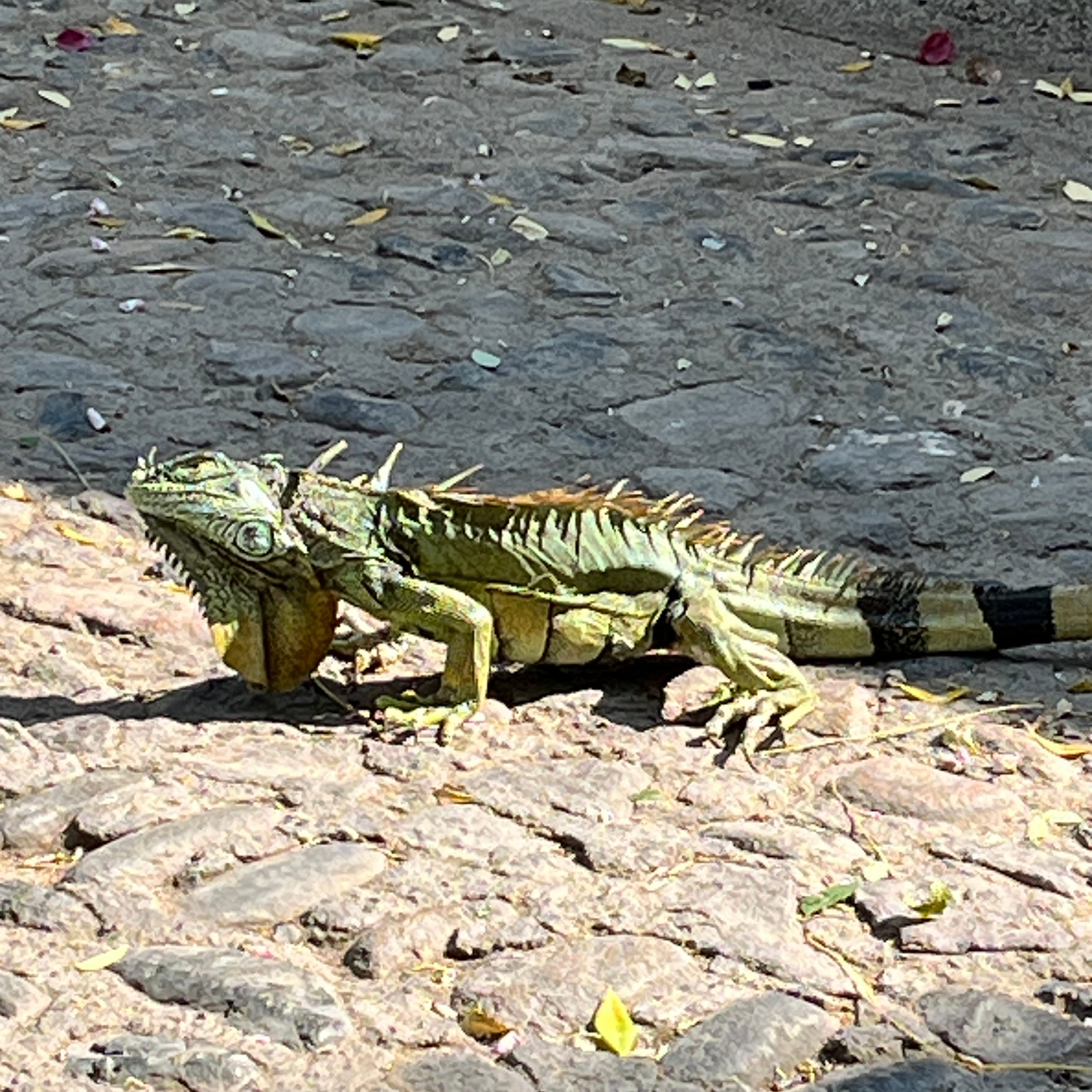
Choosing whether to see the beast as beautiful or ugly was a worthy topic, as we nursed Margaritas a bit further on. Sunlight had drawn strong yellows from the nubbly green armor. His sub-tympanic scales were like jewels dangling from his lobes. Spikes up his back flopped like some sweaty punk’s post-mosh mohawk. I would not want him to bite me, or move too quickly my direction.
Pretty? Ugly? Maybe just beautiful. Nature can be hard to categorize, for being outside human design. Still, iguanas do not mystify me. A childhood friend’s older brother kept one in a large glass tank in their basement. My friend fed it live white mice. We would bike to the pet shop together, to acquire them. For the record, I went along to look at tropical fish. Back home, he would patiently wait to watch the iguana take his meal. Watching these meals be taken taught me something about life.
Back in Vallarta, and forward 45 years to last Tuesday, while riding in a snorkeling boat we were shown one exposed corner of “the mansion where Richard Burton’s ‘The Night of the Iguana’ was filmed,” on a hillside over Mismaloya. The rest of it was grown over with jungle. An aerial map checked later showed graffitti-covered structural remains on the site, which the internet now lists to be a park.
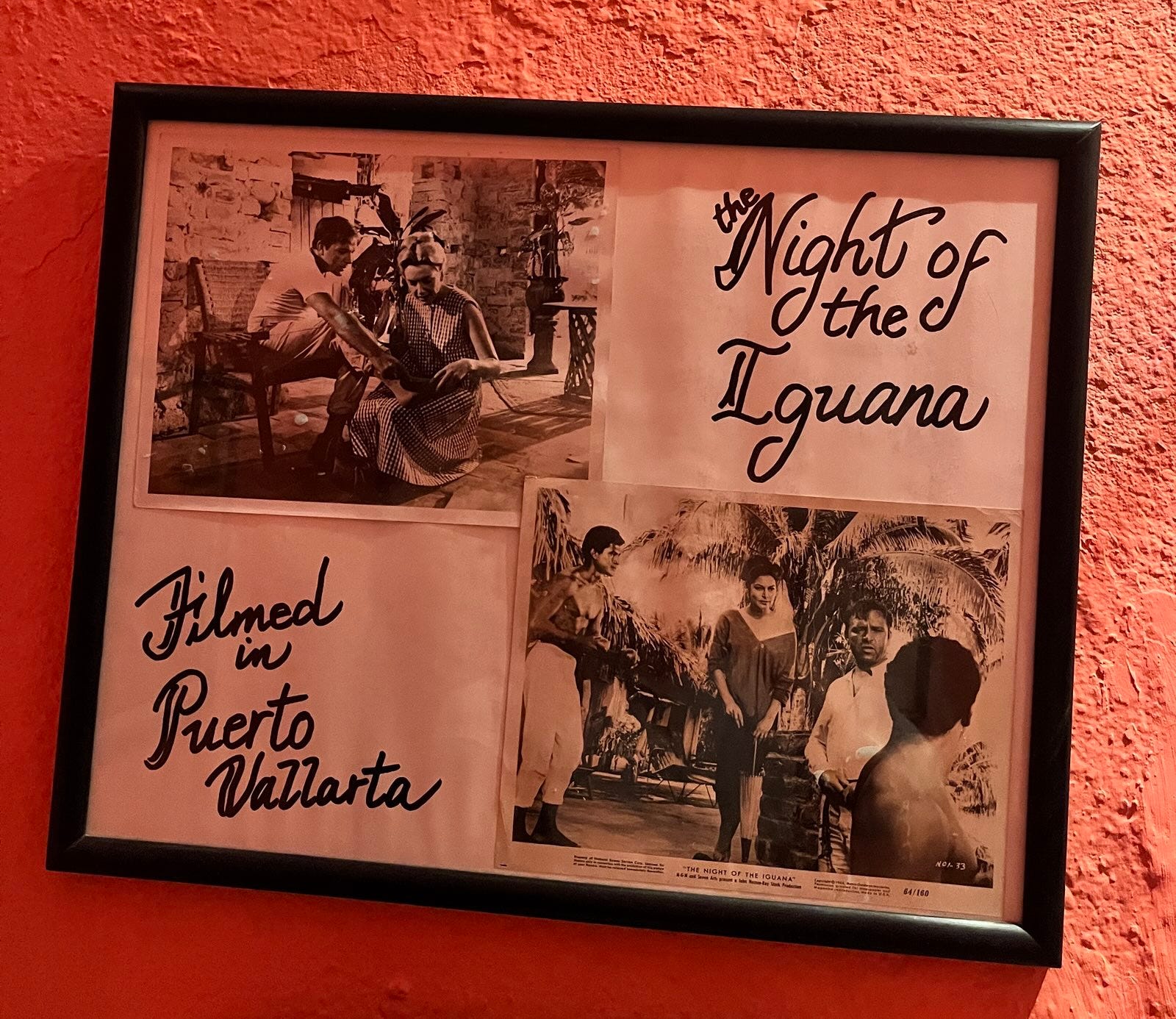
An art museum guide said this film roots the local tourist industry in its own history. This movie launched Vallarta as a vacation destination. He has never seen it. It will be shown at his employer’s upcoming fundraising gala. He may not watch it.
It occurred to me that The Night of the Iguana is to Puerto Vallarta, Mexico, as The Sound of Music is to Salzburg, Austria. Not much loved by locals.
The museum guide spoke to his boss in rapid-fire Spanish, Latin America’s other colonial language. Like the movie, the posters for this gala are in English.
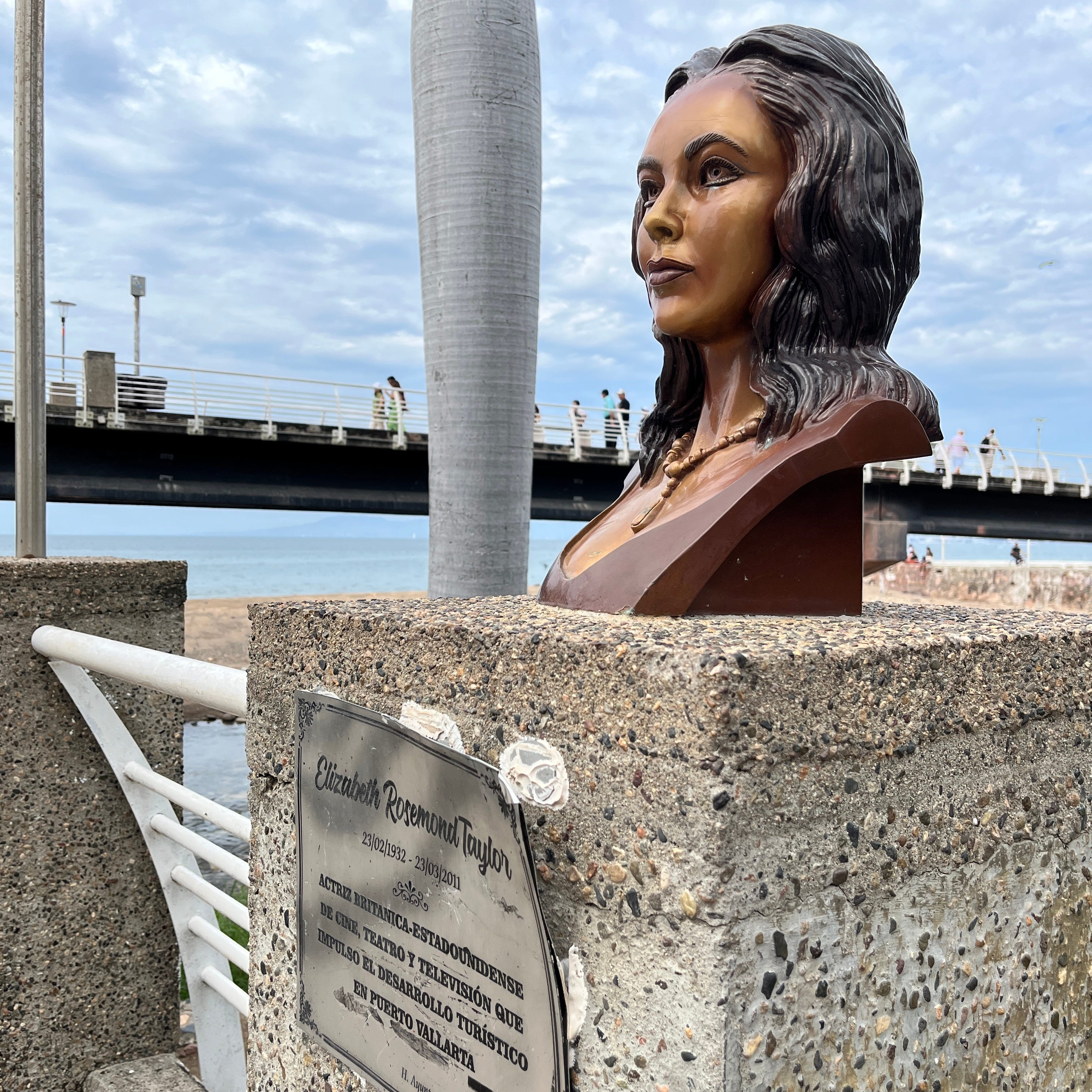
Damage to the Richard Burton and Elizabeth Taylor statues on the Isla Cuale added nuance to wandering around Vallarta as a middle-aged white guy. Covid-era escapism flooded this city with even more condos, construction workers, rising rents, displacement, expatriate retirees, and other reasons to drink.
People seemed mostly to be enjoying themselves. Tourist-zone prices for food, drinks, and housing were nearly as high as similar items would cost back home, but not quite. A vague nod remains to Mexico being a vacation bargain. Popular demand apparently bears the rising prices, so far, and local folks need all the money they can get. Stroll away from “the zone” and poverty shows up quick.
It felt useful to explore my expectations, and reactions to this poverty, as a gay man. Gays and Lesbians have long known how to escape to the margins and carefully reveal our beauties there. Until very recent years, we often had no other choice.
Vallarta was a sleepy port town before Iguana came along. Gay historic choices to escape here en masse have directly or indirectly driven much of this tourist economy. Puerto Vallarta has been known among the gays as a vacation mecca for many decades. Real estate agents have long known to follow the gays. Our annual events flood the streets with color and art. Our bars are anchor-tenants of the Zona Romántica party scene. One of the largest is the last surviving outpost of C.C. Slaughters, a once multi-city gay bar chain, which began its storied life on Portland’s Southeast Stark street in the 1970s. Ask me how I know. We could hear the place throbbing along with its neighbors every night, from our sixth-floor balcony, four blocks away.
The sound was oddly comforting.
Over a dozen new condo buildings, in various states of completion, and varying degrees of daily attention by workers, were visible from the rooftop pool where we spent our late afternoons. Floating in our privilege. Across the street, a very old walled-court building and garden had been recently reduced to rubble; its grove chopped to stumpy remains, awaiting removal.
A local friend said this garden had been the longtime site of a much-loved Italian restauarant, Tré Piatti, until just a few weeks before. “The best Italian restaurant in Puerto Vallarta” still exists, but now splits a ground floor retail box, in a big new nearby condo, with an exceedingly straight-looking sports bar.
It takes a long hot drive to reach the Vallarta Botanical Garden. By the time you arrive, you are ready to be stunned by something cool.
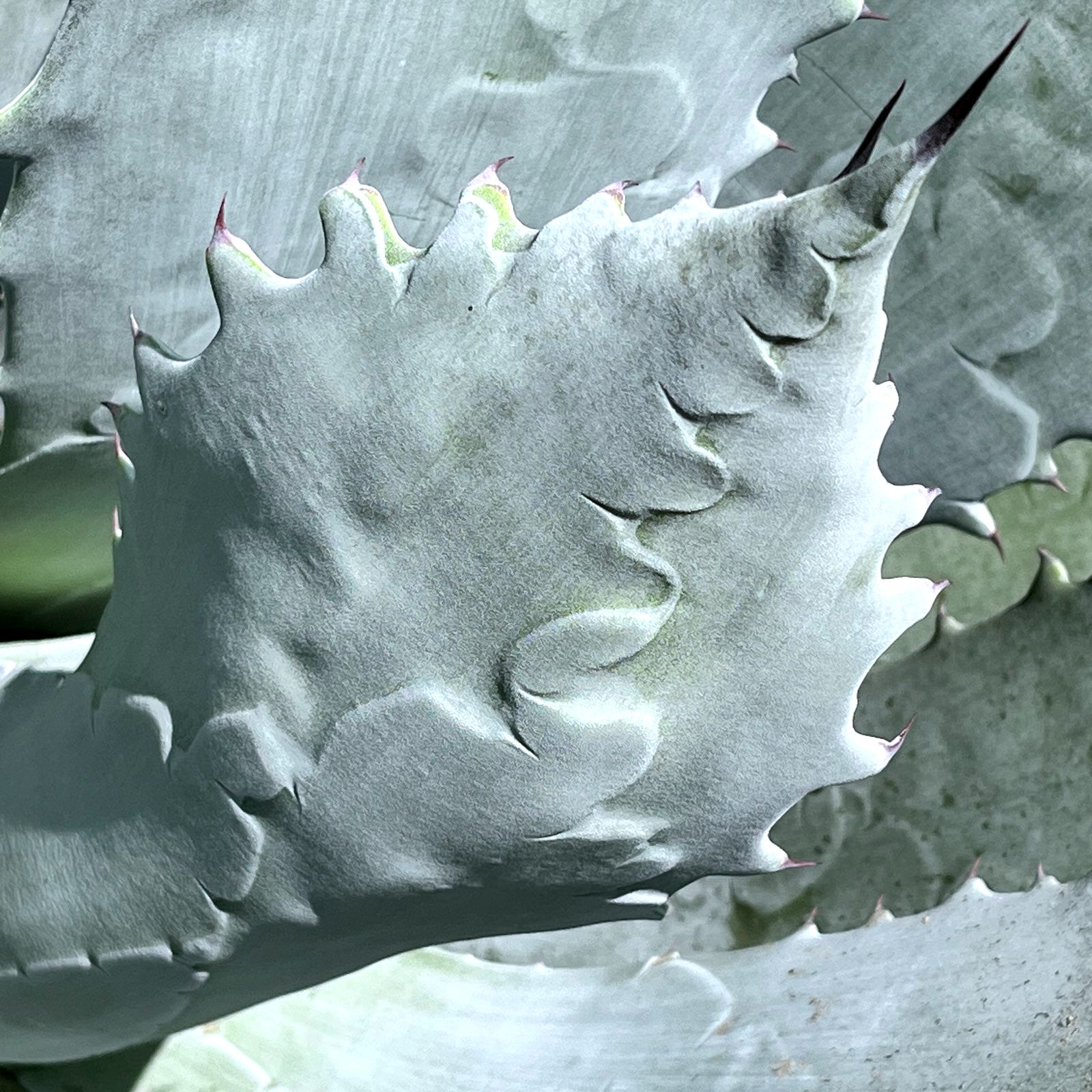
Its riverfront slopes are covered in climbing vanilla, and a seeming hundred more orchid varietals. One of the garden’s showpieces is a small chapel in its International Peace Garden1. Inside this chapel, typical religious objects are surrounded by vividly modern frescoes of the local flora and fauna. Just outside the chapel is a “garden of memories” full of memorial tiles. These tiles include a noticeably high number of same-sex couples, for those who notice such things.
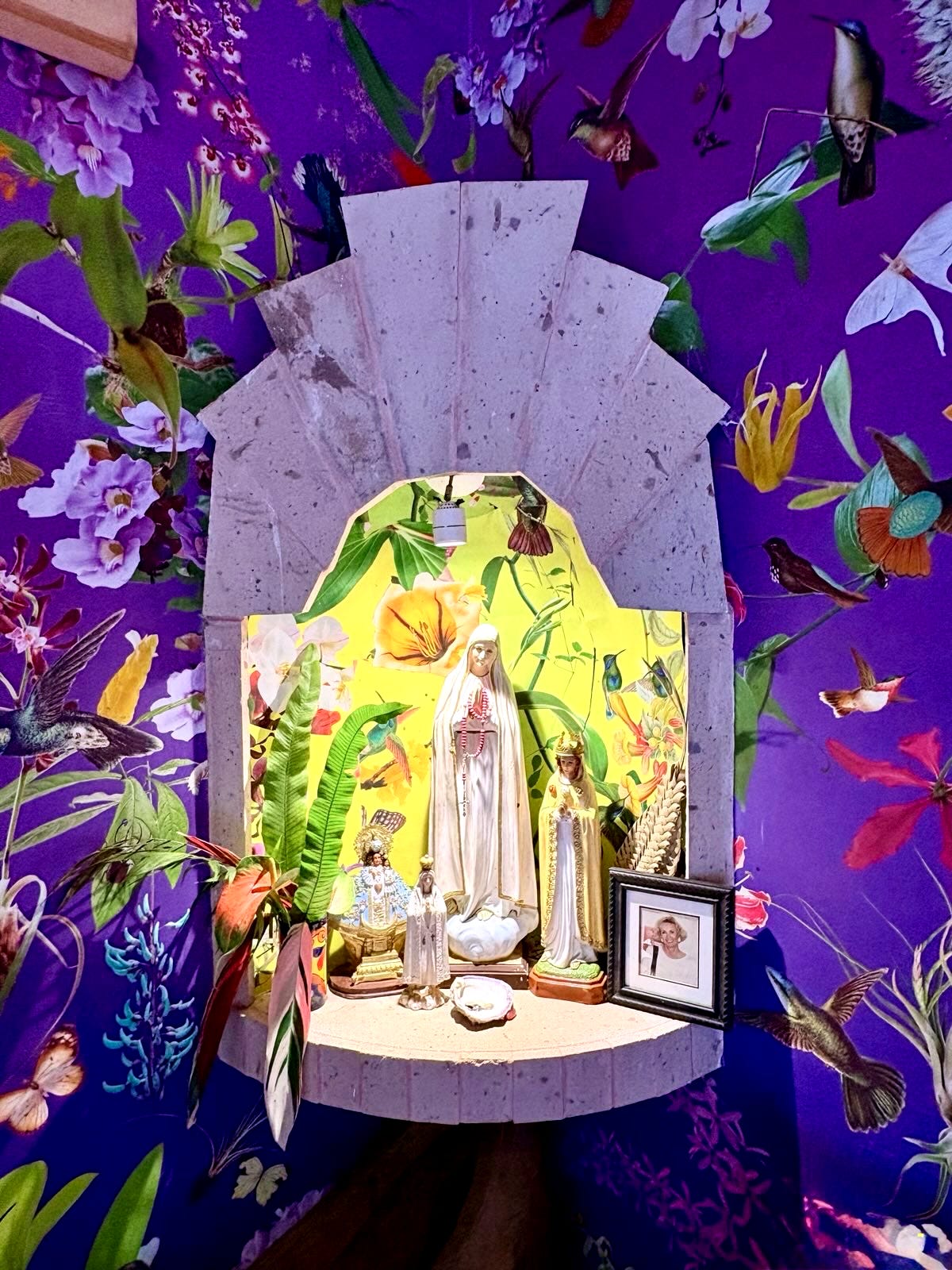
The chapel frescoes are an art project titled Fallen Fruit, made from hundreds of garden photos taken by its creators, David Allen Burns and Austin Young.
All the painted tiles and memorial headstones were no doubt placed in accompaniment with donations, long volunteer hours, and extensive love and devotion to this beautiful cause. A garden like this does not make or maintain itself. It takes years of ongoing community building, dedicated fundraising, and steady local engagement to create and pay for a destination such as this.
Our Lady of the Garden is the gayest chapel I have ever seen.
In my family, whomever wakes up first makes the coffee, even on vacation. I take mine black, my husband takes his with cream. I tend to wake early.
When I pour the cream in his cup, there is a brief moment, really just a flash, as the white drops into the black and displays itself in stark relief. The rippled edges of a lactic mushroom cloud billow through the dark. Then edges soften, spread, blend, and a tan color appears, of some shade or another. If too dark, I add more cream, and if too light, more coffee. Stir. We all know this drill.
I recognize the tone he prefers. Myself, one long black pour, and the cup is ready.
There is a beauty in this Brownian motion2, as the cream takes up the coffee, and the coffee takes on the cream. Both distinct, but destined to become something different, together, even preferable. Still, it’s pleasant to be there for those first moments, while the contrast remains. To appreciate the now of it.
International Peace Garden Foundation - map
Brownian Motion: the random movement of tiny particles suspended in a liquid or gas