

Ned Ludd, Aging, and a Hope for Ethical Tech
Instinct sent me on a road-trip last week. I spent time with friends, and alone, asking "who benefits from technology?" My soundtrack was Magnifica Humanitas.

Instinct sent me on a road-trip last week. I went to nurture six friendships in three couples I have come to know; two of them straight, one of them queer (not gay). Laughs were shared. Stories told. We drank the wine.
Along the way, I interrogated myself over the privilege I have, to even consider going on a road trip in July of 2026. My inner dialogue was typical of someone who spent 36 years living in Portlandia:
Inner Inquisitor: “The Strait of Hormuz is bent with American bombs. How dare you drive 1,800 miles to visit friends you could watch on Zoom?”
Me: “Zoom calls are thin stew compared to being welcomed into a friend’s living room, eat their curried chicken, meet their new cat, and struggle with the lighting by their guest bed. And besides, I want to listen to audiobooks.”
Inner Inquisitor: “But, you are polluting the planet with car exhaust!”
Me: “I know. And, I know my carbon footprint, thanks. Michael and I have no kids, our car gets 36 mpg, and we performatively recycle, even out here in Montana, where there is nearly nowhere to take old packaging but the dump. Besides, eco-shaming individual travel choices is a corporate propaganda tactic to deflect attention from industrial-scale pollution.”1
I spent most of my week travelling scenic byways I have never seen. I have now almost been to Lobster Valley, Oregon. Not many can say the same.
I was happy with my audiobook selections, even if I screw my own eyes at the irony of burning 50 gallons of gas while listening to them. I want to know more about how western ethical culture is trying to respond to the ways automation and AI are impacting humanity.
Magnifica Humanitas, by Pope Leo XIV. An encyclical restating the Roman Catholic church’s support for human work and dignity, now in the face of AI.
The Story of Christianity, by David Bentley Hart. An academically-sound survey of how the world’s biggest faith tradition grew into a disjointed mess.
Against the Machine, by Paul Kingsnorth. A compelling neo-Luddite2 rant about how mechanization erodes what it means to be human.
Was a week made full by nurturing six friendships, exploring scenic backroads, and listening to great and good teachers about humanity and ethics, worth the carbon load I added to the atmosphere?
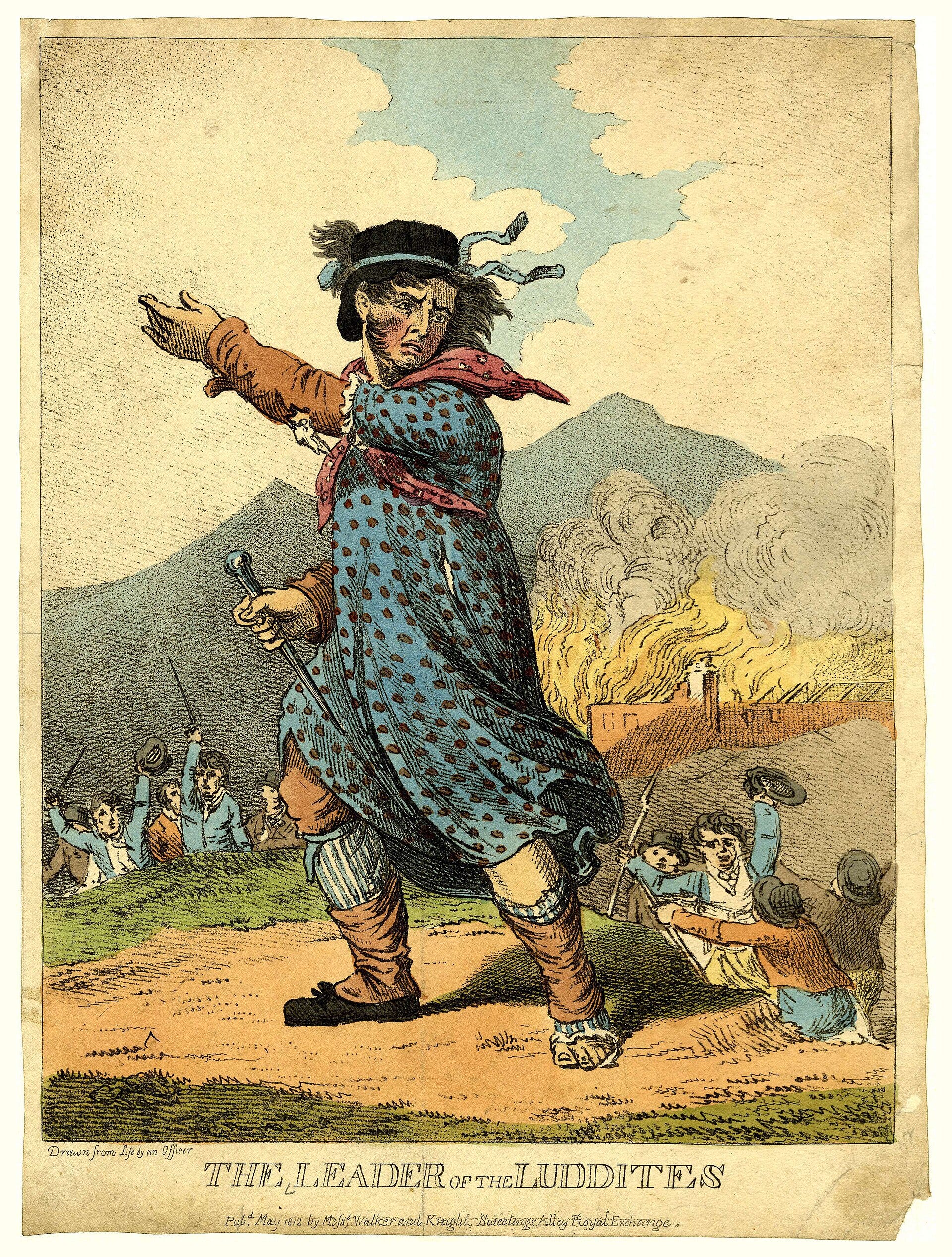
Ned Ludd was the mythical leader of an early Industrial Era movement in England, which evolved to oppose technologies designed to eliminate jobs.
“Their struggle for control of their labor became a movement that cast a suspicious eye at new technology and asked ‘Who benefits?’”3
“Just as Luddites were against the inappropriate application of a specific technology and not against technology, per se, neo-Luddites struggle against the undesirable elements in technological change while seeking to retain the desirable elements.” Notes on Luddites and Neo-Luddites.4

A self-described misfit anarchist friend of mine sometimes reads Old Truck Good Coffee. He offers occasional comments, public and private, sometimes chiding my willingness to speak to the middle path: that politics is the art of compromise as much as the craft of social posturing.
Recently, he pointed me towards a new ethnography of conservative, rural Americans, and the varying ways they view democracy. It is titled “Faith, Family, Freedom, Place: An Ethnographic Study of Conservative Americans’ Relationships to Democracy.”5
This report analyzes and describes a type of folk I know here in Montana, including many of my relatives. People I sit down to dinner with on the regular.
Page 21 of this study attributes the following to a Minnesota man named Jordan:
“Conservatives will see a fence and ask why it’s there before they decide whether or not to tear it down, where liberals will see the fence, tear it down, and then ask why it was there.” - Jordan (early 30s, MI)
This simple metaphor has stuck with me over the weeks since I took my friend’s suggestion, and read the report.
My hot take is that, as trivializing as this quote is to the progressive preference for direct action in pursuit of immediate justice (or at least rage), it also offers a valuable thought on looking before we leap. On asking “why is that fence there?”
Nothing new here, of course. Strategic questions of when to act, and when to pause, are as old as the very first thrill of the hunt.
(There will be an OTGC podcast discussing this report sometime soon!)
Turning sixty this spring left me noticing some age in my bones. I care for my joints with a daily set of joint rotations; but, aches persist, and a few joints no longer work as they did. Every body reading this will either die young, or feel the same at some point. The later the better, but reality pops us all out eventually.
A few nights ago, while standing in the kitchen with Michael, washing up from dinner, we talked about his father’s need for memory care. Thinking about dementia, while feeling my aching knee, queased my stomach for a moment. I had an insight flash into the way aging involves an ever-growing vulnerability; one we can stave, a bit, and ignore, but never eliminate. We soften, grow weak.
While young, we can imagine ourselves doing anything, and at least half-believe it true. For the lucky ones, it is. Heroes exist. So do good genes and silver spoons.
But, we are born on a track. We have a precious, but uncertain, amount of time, will, and talent by which to drive ourselves through life. We launch, arc, hop a little or a lot, peak, slow, view the scenery, and eventually fall. Every one of us.
All the way along, we are dependent on the societies, systems, and natural laws enmeshing us, whether we see them or not. Whether we respect them or not. Whether we tear the fencing or ask why it is there. Experience—the most literal byproduct of aging—makes our track more apparent as we drive. We see what we have been taking for granted, as potholes widen, roofs leak, knees creak, prices rise, joints swell, and leaders launch more wars to feed the machine that gave them power, and us comfort.
Awareness of vulnerability—some imagined, some real, some imposed— leads to the common political conservatism of the elderly and the poor, who staunchly vote to protect their “home.”
I feel this. Recorded human history is only a few thousand years old. Humanity has been chewing up our only planetary home—like some out of control teenager—for two to three centuries now, since the dawn of the Industrial Age. Our humanity is a renewable resource. Babies exist and culture evolves. But, coal is not, and neither is the cobalt inside the device on which you are reading this.6
“Humans have mined about 4.5 million metric tons of rare earth elements so far, and we know of only 90.9 million metric tons left on Earth. At today’s production rates, we will run out of these materials in 60 to 100 years.” - Scientific American, November 18, 20257
Occasionally, while scrolling, I feel my mind being mined. My time and attention being extracted in exchange for little rewards that sizzle in my nerves. When I am able to step away from the sizzle, I want my time and attention back. And, I also know this craving leaves me, if I put the phone away for a couple of days.
The act of sitting next to a friend, in a real, physical room, full of texture and scent, telling stories and exploring notions, cannot be replicated by technology, only facilitated. And, there’s the rub. On one hand there is facilitation, and on the other, replication. Imitation. Fabrication.
Industrialization.
Yes, technology extends our human reach with tools. But, technology also automates, mining traditional human skill sets, and grinding away at the dignity of labor, for the benefit of corporate shareholders.
How does it feel to be a coal field?
Thank you for reading Old Truck Good Coffee.
Please take a moment to Like, and to Restack or Share this post.
We are real live humans, and your button clicks help morale!
Eco-shaming is, of course, a complex social phenomenon.
Kimberley Vandenhole, Thomas Block & Tom Bauler (2025) The cultural politics of eco-shaming, Sustainability: Science, Practice and Policy, 21:1, 2440951, DOI: 10.1080/15487733.2024.2440951
“Luddite - Luddism is a philosophical movement that critiques the impact of technology on human life, asserting that it has alienated people from nature. Originating in late 18th and early 19th-century England, Luddites emerged during the Industrial Revolution as a response to mechanization in industries like textile manufacturing. This mechanization transformed labor into repetitive tasks, diminishing workers’ roles and leading to job losses, prompting protests that sometimes involved the destruction of machinery. Named after an urban mythological figure, Ned Ludd, the movement symbolized resistance to the rapid changes brought by industrialization.
“Luddite,” Cunnington, Trevor, PhD (2022).
Ibid.
Ned Ludd was a mythical figure invented by storytellers in early-industrial England, which inspired workers to question who benefits from mechanization, and who loses.
“In particular, neo-Luddites argue that technological development is not necessarily equivalent to technological progress.”
Notes on Luddites and Neo-Luddites.
https://www.sfu.ca/~poitras/luddites.pdf
Faith, Family, Freedom, Place: An Ethnographic Study of Conservative Americans’ Relationships to Democracy, by Scott Warren. SNF Agora Institute (May 14, 2026)
“Mined into extinction: is the world running out of critical minerals?,” by Julian Turner; Mining Technology (April 9, 2017).
https://www.mining-technology.com/features/featuremined-into-extinction-is-the-world-running-out-of-critical-minerals-5776166/?cf-view
“Will We Run Out of Rare Earth Elements?,” by Clara Moskowitz & Studio Terp, edited by Jen Christiansen; Scientific American (November 18, 2025).
https://www.scientificamerican.com/article/can-we-find-cleaner-ways-to-extract-rare-earth-elements/