

Fascism is what happens when you listen to the radio alone
Let's be clear what is happening on social media platforms.

Theodore Adorno (born 1903)1 was intellectually heads and shoulders above most of us. By 1939 he had penned music, music criticism, philosophy, and social criticism that are still useful today. He saw into the future of music, culture, philosophy, and fascism.
He also refused to conform to the simplified desire for data and metrics of his day.
As a refugee from Nazi Germany, he was invited to New York to join a Rockefeller-funded study of radio in 1939. The key researcher, Frank Stanton, was director of research (and later president) of CBS. While Adorno was curious about context and aesthetics, Stanton wanted to sell soap during soap operas.
Stanton and his associate Paul Lazarsfeld invented possibly the first like button. They ushered subjects into a room, gave them a like button and told them to click it when they liked what they heard. They also got a dislike button, something that is controversial to this day in social media platform design.
Then the researchers played the radio. On an old fashioned tape, they recorded the likes and dislikes.
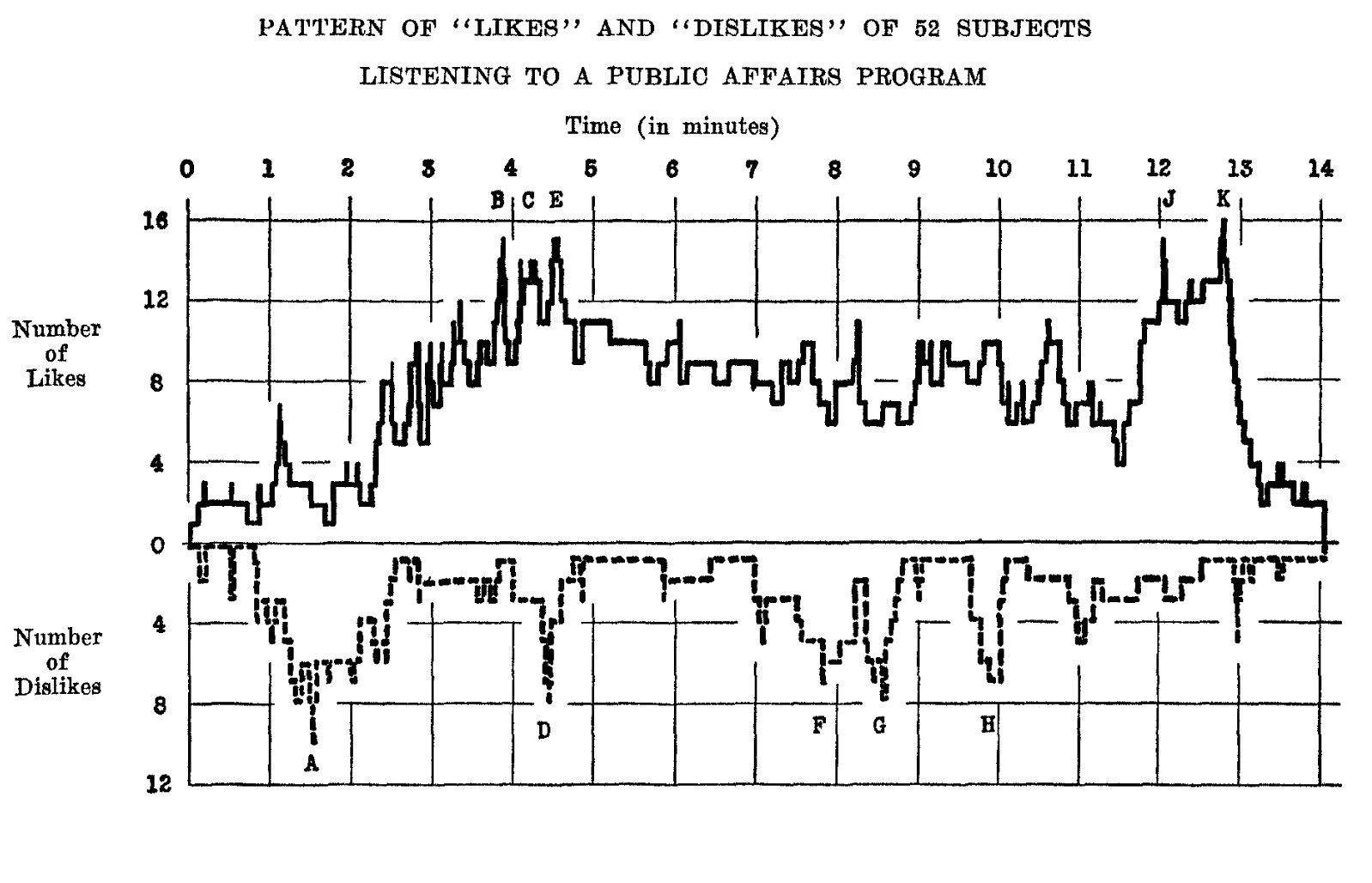
This was not an environment that Adorno could work in. He felt that this process was a totally a misleading gauge of an audience.
“I reflected that culture was simply the condition that precluded a mentality that tried to measure it.”
Adorno tends to, in even my secondary reading of him, use pretty sophisticated ways of saying things. Or perhaps he was being polite to his hosts. I take it to mean
Culture and taste refuses metrics. People who try to measure it are dumb.
Adorno left the project shortly after. Lazarfeld co-wrote a paper a few years later contradicting the project, saying that analysis of content and in-depth interviews were needed to understand audiences. Simplistic metrics don’t cut it.
But Stanton got what he needed out of the study. Strategies for soap selling have been refined with these numbers ever since.
I learned about this story first from a revealing article from Carina Albrecht, Discerning Audiences Through Like Buttons.2 It also reminded me that many of the creators of our addictive apps (including the Facebook Like Button) have regrets and don’t use them.3
Triangulating their concerns with Adorno’s observation of radio, it seems that we are not treating these powerful forces with the obvious understanding of what they do to our ability to reason. Adorno said (in his still roundabout way)
“The authority of radio becomes greater the more it addresses the listener in his privacy,” while “an organized mass of listeners might feel their own strength and even rise to a sort of opposition.”
I translate this as
Consuming media alone perverts you and makes you easy to manipulate. If we are together, we just might have a chance against it.
Or
Fascism is what happens when you listen to the radio alone.
The new hyper-tuned platforms (depending on your generation Facebook or Tik Tok but also this here Substack is using the same principles for disseminating fascim) use features built and refined from massive amounts of data just to keep you hooked. Then, their owners pretend that their motivation is community building.
We consumers try to maintain our sense of power and agency by saying that we are not affected by them.
Pull down to refresh, a slot machine handle.
Infinite scroll, a never ending quest.
Notifications, hope tapping you on the shoulder.
Pick metrics or narrative; neither the numbers or the stories support our theory that our agency is more powerful than these features. You would not be able to discern if you are subject to this, so I don’t trust you if you claim you are the exception.
More than a few people feel that our digital media consumption is one reason for our political climate and social divides. I agree.
After the inauguration where the operators of all of our platforms sat behind Donald Trump then doled out massive checks to spoil him, I polled a group of activists that I communicate with on a Facebook group. Would they be willing to migrate to another platform?
One person spoke for them. I paraphrase:
Let’s use their platform. I am not influenced by their ads.
I don’t believe that person. But, we still use Facebook. I am constantly compromised into using these ad-revenue-creating monstrosities.
And now here I am creating for one, Substack. And wishing that you were addicted to me. It does not feel great.
My understanding of the tech world is better than most. So is my understanding of the business models. I am confident that the technology to have a social media experience or a writing-publishing experience could be separated from addictive platforms.We could all spontaneously move to Mastodon4 and our attention would not be funding people trying to make money from our attention.
We could log in to a platform in which our friends are more than 7% of the content we see.
But, we are captured by the value of our friends and we can not collectively sell all of our friends and family on the change. And some of us feel that more than entertainment is here. That our future of communicating outward to you is here. I want to believe it is worth it because I have not come up with a better alternative.
Thanks for reading. Like and subscribe.
Great Wikipedia article https://en.wikipedia.org/wiki/Theodor_W._Adorno
https://hdsr.mitpress.mit.edu/pub/nf9bhik3/release/1#n16yeqrpsy6
https://www.theguardian.com/technology/2017/oct/05/smartphone-addiction-silicon-valley-dystopia
I would love to socialize with you there https://mastodon.social/@joelbarker
If I like this and record that fact, am I giving in? Is there a middle path? I wonder how Zuck's face looked the moment he realized FOMO would be driving people to give him money until the lights go out.
Excellent article. The model doesn’t spread only fascism, though. Anything powerful has potential for good and for evil.