

Degrees of Time and Learning
A pilgrimage story

Two weeks ago, a fraternal brother and I drove 21 hours in 2 days, from Helena, Montana, to Guthrie, Oklahoma, for a three-day live performance of 29 mystical and philosophical morality plays.1 It felt like a pilgrimage.
Along the way, at my request, we stopped at the gravesite of an old friend of mine. His headstone is set in the cemetery of the tiny Kansas town where his parents adopted him from a mother he never found, despite great efforts. Efforts that ended with a government letter telling him to stop looking; or, so his brother reminded me at graveside.
Looking over the headstones resting quietly under a fluffy Kansas sky, I recalled this story myself, from a long-locked trunk in my head. This trunk also let me recall how William S. Burroughs had become a friend of my friend in college, over coffee Darren would serve him, in the college-town café where he worked while earning his degree. Burroughs was a flirt.
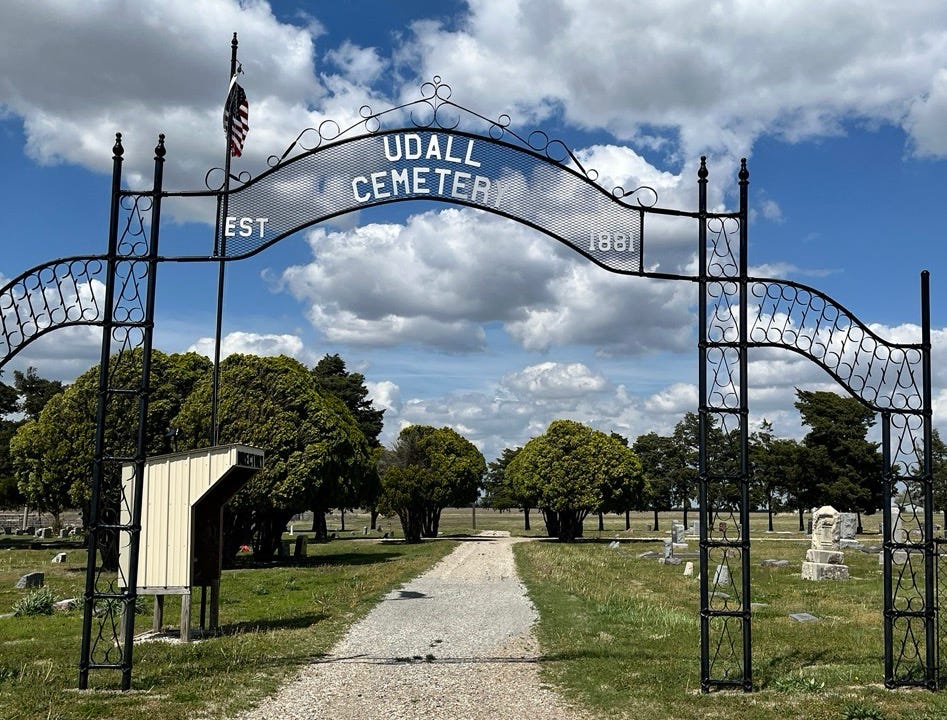
My friend and lover’s adoptive brother—now the local fire chief—and I had first met many years ago, briefly, once. It had become my role to pour Darren’s ashes into the ocean at Oswald West State Park, a beachfront for connoiseurs of the Oregon Coast. It was my duty, as a friend and former lover, to do so over family objections, if any. This was Darren’s will, and a good one, under circumstances particular to his family, and to the age of untreatable HIV/AIDS. At his brother’s request, though, I had allowed a small portion of the ashes to travel back to Kansas. No, his family could not have it all. It was much too late for that.
Those spoonfuls of ash were now mingled in the soil below a headstone I was viewing for my first and only time. Which was sitting next to the headstone of “a loving father and friend” of whom I had heard unspeakable tales.
Despite those tales, and my own, Darren’s brother had still listed me in the local obituary, nearly thirty years ago, as an honorary pall-bearer to his brother. To return his respect, I now offered him some photos that no longer bring me tears.
We will never see each other again.
This hour of memento mori, in a remote graveyard, was not off-point for what came next. Less than two hours further south we arrived at one of the largest Masonic buildings ever built; a temple for remembering death and resurrection.
The next three early mornings were spent in an elaborate, copal-scented room, engaging in contemplative practices before moving into the big, old, leather-seated auditorium, to witness the day’s degrees. No one was permitted in the third and highest balcony. The 1,500 or so available seats have likely not seen a full house for many decades, though there are photos of the glory days, dating to before the First World War.
Still, on each of our three days, hundreds of men were scattered around inside this century-plus old edifice, setting stages, running lights, rehearsing lines, adjusting wireless mics, making food, smoking cigars, talking with brothers, and reading quietly in the rippled glass and carved wood library, or one of several exotically-themed lounges.
At one point we were told 493 men had volunteered to make this weekend happen. The entire event—including months of labor leading up to it, and a week of tear-down following—was an outpouring of old school volunteerism, undertaken in service to moral, chivalric, and philosophical enlightenment. An educational experience dating from an era before highly specialized (and expensive) college degrees became so common as today.
This all happened in a town of 12,000 people, in northern Oklahoma, not far from where tornados hit this past Friday. It felt … inspiring … to learn how a college of mystical interreligious studies, expressing itself through dramatically staged, highly literate rituals, has been dotted across the United States, and woven into the now-fraying American cultural fabric, since 1801.
It takes very little research to learn that philosophical lessons, framed around death and resurrection, have never been limited to the Christian church. The Way is not exactly hidden.
Three days later, my fraternal brother and I drove 1,400 miles back home, including 17 hours in one very long day, crossing stretches of Kansas, Nebraska, Wyoming, and Montana. We largely kept to state highways and local byways. We drove past lots of small town cemeteries and museums.
There was a time when we humans had to meet face to face, if we wanted to dramatically communicate vast philosophies, in ways that touch the heart and punch the gut. Now we have YouTube and a cereal bowl.
The first called upon armies of volunteers equipped with scripts, props, and mythologies. The second requires data centers, sucking up aquifers once used for growing food.
“The System of Degrees,” of the Ancient & Accepted Scottish Rite of Freemasonry - Southern Jurisdiction (Historical and Monitorial Introduction)
https://scottishrite.org/wp-content/uploads/2021/09/Monitor_and_Guide_3rd_Edition.pdf
YouTube and a cereal bowl. Funny yet sad image.