


Full title:
An un-comprehensive contribution to the recent SubStack back and forth on those wild and pointless sentences of some folks, seemingly largely French, who resided in philosophy departments and went about infecting literature departments and also arguably our culture with some ideas that whether they are salient or not is hard to discern as they are largely incomprehensible.
This article was important enough for me to write, after enjoying the discourse between the writer’s mentioned below. It diverges a bit from the style and topics we typically put into Old Truck Good Coffee. If you are a regular reader, please enjoy some variety. If you are a new reader, thanks for taking the time. Our hearts are in finding how to bump along interchanges and this topic is definitely one. If you don’t like long sentence philosophy jabber, wait a week and it ought to have passed out of here like the smell of burnt coffee or the sight of a Honda truck.
Discussed
Why It Is (Maybe) Safe To Conclude Some Legendary Thinkers Are Charlatans Without Reading Much Of Their Work by Jesse Singal
On Bigotry, Bullying, and Tribal Enforcement by James Meacham
Resisting the Epistemic Argument for Compatibilism By Patrick Todd and Brian Rabern
A Bulldog in The New Old Academy
I appreciate Bentham’s Bulldog for raising the question of the group known as Critical Theory, deconstructionists, post structuralists, and Those Damn French Quote Unquote Philosophers. I also appreciate Jesse Singal and Ted Gioia weighing in and James Meacham’s points about the political impact of it. If you also wrote on this issue and I did not get a chance to read it, please comment or message me. I want to hear!
I love to wake into the hard topic of meaning. It is never ending. We are without conclusions. For me, it is like talking theology; I am going to trust you more if you start by throwing up your hands. This stuff is hard to talk about.
In my mind, the contorted language of Kristeva, Foucault, Lacan, and Derrida are that gesticulation. The text is expressing that writing about how writing works is going to result in some short circuits and some dark spaces.
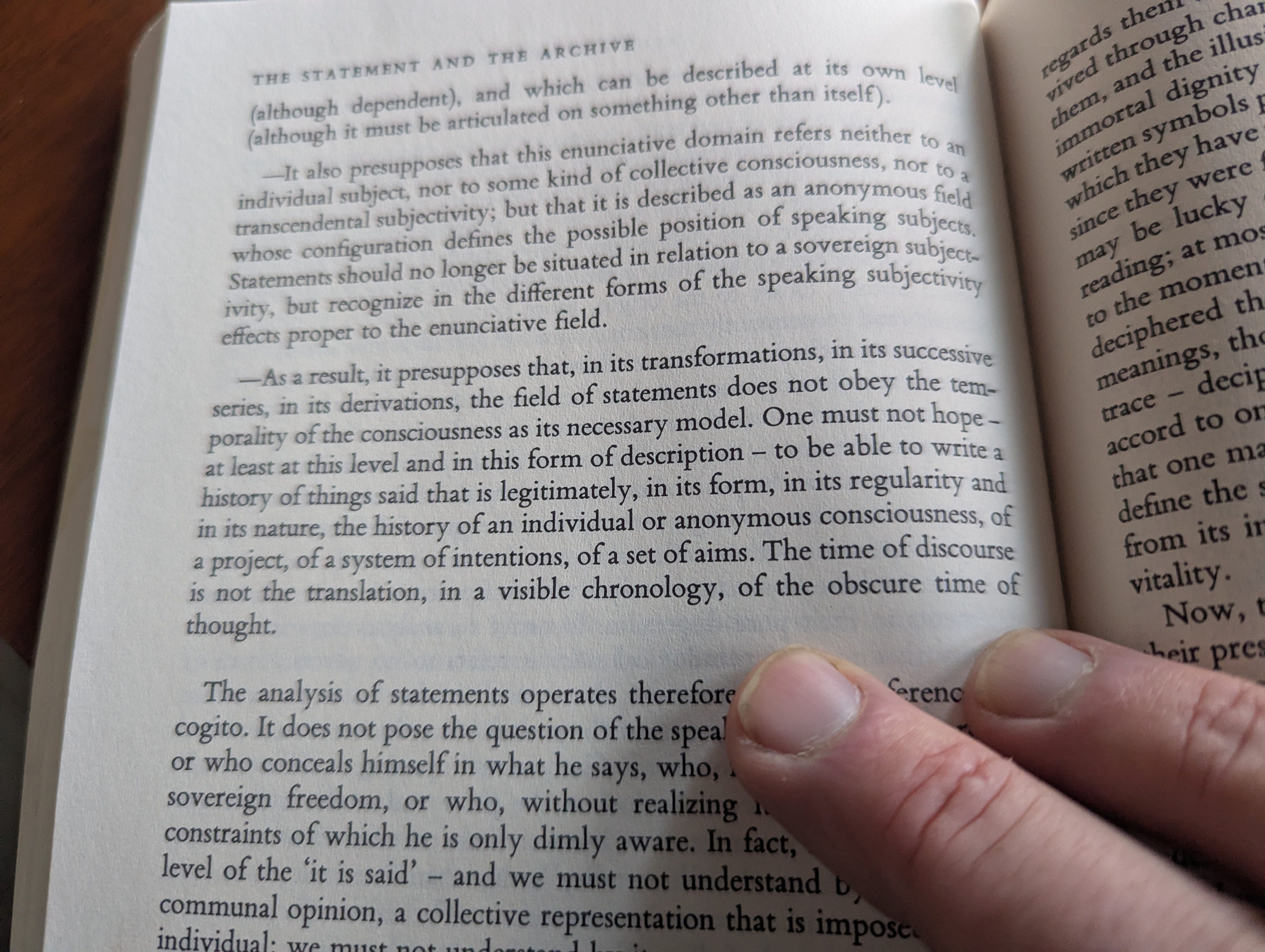
This worked well for me when I first learned of them. It continues to, with some personal modifications. I don’t read these folks as some insult to myself or a challenge to my ability to read. When I delve in, I see them as putting the writer and the reader side by side, looking out at the difficulty before us.
I need to confess that the chosen victim of Bulldog’s attacks and ChatGPT mimicry, Judith Butler, is not someone I seek out. I have not read a complete piece of hers for quite a few years. I need to keep this apologia to a broad scale, not the defense of a particular writer. That seems fair in that Bulldog and Singal broadly impugn their entire camp. I would expect no one responds to me with particulars outside of either our broad scopes to prove or disprove a generality.
I will say: These writers have a significant place for making me who I am. I hope that others are not too turned off by the feelings of Singal and Bulldog and Meacham. These philosophers’ works are, if you allow them to be, multi-dimensional structures for more deeply exploring how meaning actually works.
For instance, political language. Deeply considering the exercise of Derrida’s Différenceis pivotal to my understanding that the imperative phrase “make America great again” functions differently for you based on what is meaning-adjacent to the word “America” for you. Understanding that the meaning is not inside the word but inside each individual audience member, I know that the phrase decodes differently for different people. The speaker self-selects listeners who have a particular set of images associated with the idea of America.
Similarly, odd grammar, unnecessary capitalizations, and all caps writing looks dumb to some but sounds familiar and builds affinity to others.
Thanks, Jacques and Michel.
The intellectual journey alongside Jacques, Michel, Julia, and the lot leads outside the familiar humanist tradition of Greek and Roman inquiry. They are far from Aristotle, for which I am grateful. But as I am not pitting the two (two-ish) camps against each other, I can celebrate, enjoy, and utilize BOTH! Each is inevitably flawed and critiqueable but folks like myself find value in them BOTH. The parsing philosophy that Bulldog points back to does some good lifting, but an iteration was called for.
These thinkers function after some precipice in the rear view mirror back there where (in my view) Enlightenment thinking has shown the frailty of a world confidently chopping itself up into smaller and smaller units in search of Ultimate Comprehension.
The idea that we must come to a strict definition of something has a rational basis, so in Resisting the Epistemic Argument for Compatibilism, the authors start out with some parameters…
In this paper, we focus on what certainly seems to be the most prominent such argument: what we propose to call the epistemic argument for compatibilism. Epistemic arguments of the relevant kind proceed from epistemic premises – premises about our knowledge or evidence – to substantial metaphysical conclusions.
… and reference previous definitions of words to develop consistent dialog. This is super great.
Derrida & company can hunt backward and reduce those definitions to contortions that threaten to be meaningless. I don’t want to do that today. I want to read about the positions of the authors on whether, using their prodigious knowledge, they see any merit in the idea that free will and a predetermined fate can co-exist.I hope I got that right. I am not an exceedingly well trained reader of philosophy.
I see these approaches as Enlightenment-inspired. The Enlightenment got some stuff right, but some of the pronouncements don’t work. It is still the orthodoxy around us, not just in these ivory tower papers but in how we understand our grocery store, our relationships, and our politics.
In my life, I keep finding problems with the Enlightenment thinking. Critical Theory helps congeal that.
I encountered Critical Theory in college, as most do. A small cohort of mine smoked cigarettes (it was the 90s, forgive us our sins) while trying to restate and apply Derrida’s Différance. It changed perception like a drug. And like a drug sometimes we wished it would wear off.
I have always been very interested in language, particularly how very rough-hewn a tool it is. From a teenager writing in journals I bought at Waldenbooks, I recall noting that word meaning does not consistently transmit from me to you. Readers are constantly, independently rebuilding language as they read. That the poetic acts of writing are nodding at the frustrating near-uselessness of the very tools at hand.
So, what Derrida was doing made sense to me — after I folded and unfolded it enough times to get that useful joke (“I am trying to use language to make meaning about how hard it is to use language to make meaning”) out of him. Summing up these folks is risky business and excises the useful experiential aspect of reading, but one germ of language virus that I get is a chorus of people stating:
Language won’t do the job of describing language (and the power it transmits), but let’s try anyway.
A bit more defeatist than the Enlightenment chop chop approach, but the goal was for the patient to survive the procedure in one piece.
I would say she survives whole, but with the application of “applied theory” Meacham notes, the patient is sometimes badly bruised.
Turning from theory to application, particularly in culture and politics, the joke part got cleaved off. The joyful struggle of it was left behind for a certainty about power and meaning. The joke part just becomes the alienating “you wouldn’t understand, you are not indoctrinated.” Oh, the irony.
Re-reading Différance in my 20s in a cloud of American Spirit smoke, I realized that I couldn’t live a good life just swirling around the mad satisfaction that I am able to tear the heart out of meaning whenever I want. I had to negotiate my relationship with Critical Theory.
Meacham seems to say that culture as a whole failed to do that negotiation. We are stepping through the traps, where you can tear up a word like “justice” instead of organize around it. You can see everything, even serving dinner to someone you love, as impositions of power.
I see that “deep absence of meaning” he indicates in my political circles. It is a transmitted virus. I like truth and inquiry well enough, but it is fair to ask what the utility of these big pointed jokes are if you see them weakening society and individuals.
The glove metaphor. It’s sucky but it works for me.
I realized after swimming in these models of power and sense that it becomes challenging to constitute a meaningful life when you believe understanding is impossible. Tapping the ash from my Spirit, I adopted the glove metaphor. I still use it to this day. It is imperfect. Feel free to critique it:
My hands can’t touch or manipulate the world directly. I am always wearing some kind of glove. Strive to wear fine leather riding gloves rather than Arctic explorer mittens.
This is working pretty well for me, a few years on. Like Gioia, I make a living using words in commercial spaces. Most of the people in that world view language as equivalent to programming code. They are forgetting lots of facts to assume that. To be successful as a commercial writer, I need to not contradict them. That would create long pointless conversations in a space where billable rates and return on investment are top of mind. I skip the platitudes and go about the work constructing texts that are clear and culturally consistent.
Clients don’t know that there are poetic acts and deconstructive backflips happening in the construction process of a white paper that introduces a new technique of data storage. We are using metaphors that rely on cultural commonality. We are presuming shared narratives to transmit information and in the process signaling belonging or outsider status. We are imposing our value priorities in order to show that this product is the choicest product.
They don’t see that deeply into the writing. That’s OK, they pay me to make it look easy.
I still write for my own joy; here on Substack as Old Truck Good Coffee, in my recently published novel, and all sorts of other material. Poetry in particular — a topic for another time.
All my work with words is built on the knowledge that language is a beautiful failure at meaning. Is this an idea that Singal (and Chomsky in his account) reject?
Among the more resonant thinkers I have come across in recent years is Iain McGilchrist. His book The Master and His Emissaryis polymathic to the nth degree but is more readable than Butler or Bulldog’s AI prompt simulacra. It might contribute to this conversation.
One point McGilchrist makes is a wide view that we have (I am going to label it for my convenience) a reason system and a rationality system in our brain. This is an iteration on that old left brain/right brain research.1
McGilchrist theorizes that we evolved to have the broad-thinking, context-aware reasoning system in control. That reasoning master sends out rationalized thinking as an emissary to parse narrow problems. The rational emissary is to then bring that information back to the reasoning master for decision making.
Building on this, McGilchrist posits that culture will sometimes invert these two and the rational mind will get control. These rational cultures over-index on dissection and definition. They denigrate poetry and religion (or adopt highly rational editions of each in which the work is transactional. Poetry and worship created to achieve a quantitative value).
I am thankful to have found compatriots like Ted Gioia at this time to read and lean into reasoning. I love this phrase in Bulldog’s essay “exceeds the bounds of legibility,” though at the point he coins it I am not sure if he is talking about Butler or the imitation ChatGPT generated to his prompt (sidenote: I would loooove to know exactly what prompt he used to create that. There is an essay for him in that, for sure!). At times, I am called upon to exceed the bounds of legibility to state what is true to reason.
I also appreciate the more rational constructed philosophy that the Bulldog suggests is the one true philosophy. Stuff like Resisting the Epistemic Argument for Compatibilism(Todd and Rabern) is great reading and helps us move forward. I am happy to read them.
If I were enough of an illegible Critical Theorist, I would write the locked-in run-on sentence to run around whatever Bulldog did there. I would read it here by the fire with verve and giggles, and perhaps someone else out there would fold and unfold it, chortle themselves, and know that I also see how these texts of power, authority, and meaning do work, play, and a very serious throwing-up-of-hands all at the same time.
A quick postscript on an important resource: Grievance Studies
Both Bulldog and Meacham reference a group that is familiar to me. I was surprised that Pluckrose and the Grievance Studies group had entered canon enough to be referenced so obliquely as if they were an authority. The tale of their project is of use and significance, but I would not take it as something that gets the honorific of Meacham’s reference (merely “Pluckrose, 2022”) or Bulldog’s simple statement that “Sokal and his followers gave strong evidence for that when they submitted nonsense papers with fake citations and got published.”
It has been pointed out that at the right volume one could get false papers published in any discipline. In fact, AI is enabling that to this day. A recent conference was riddled with fake references.2 Bad research practices are being uncovered in business schools.3 The Replication Crisis continues to erode studies that were building blocks for knowledge and many people’s confirmation-bias world building.4
These Grievance Studies folks were not scientific themselves. Their process was designed for a very particular outcome. Had it failed, we would not have heard of it. That is not science.
The arrangement — send all the papers you can to all the publications you can — will almost inevitably result in one or two that get published. Academics know that the work process is imperfect. It relies on goodwill and ethics. Pluckrose and company took advantage of those assumptions. It relies on hard effort and open critique. Pluckrose and company undermined the system.
They failed to get their pieces published more than they succeeded. They were caught out rather quickly, at which point they had to hurriedly claim victory and retreat to the uncritical victory lap on Joe Rogan’s podcast.
The name grievance studies is markedly ironic. While they seem to be claiming that these papers were neither scientific or academic, the project abandons science and academia for the participants’ own grievance.
Issues remain with these disciplines and the nature of these publications. But, the fiery attempt at takedown was unethical, needlessly destructive, and proved nothing but the participant’s ability to make a life on podcasts.
Note that the use of the word reason is not a perfect overlay of Meacham’s Enlightenment “reason.” Because words slip around.
The Business-School Scandal That Just Keeps Getting Bigger November 2024 https://www.theatlantic.com/magazine/archive/2025/01/business-school-fraud-research/680669/
Oh I am so heartened to see dialogue about these topics related to real things people are thinking about and doing! That we can build on the ideas that the critics put forth while prioritizing our relationships, our communities, and our own (my own, I should own that) sanity.
This reminds me quite a lot of Wendell Berry’s 1979 essay, “Standing by Words” in which he ties an increase in language which is “meaningless or destructive of meaning” to the disintegration (that is, the dis-integration) of individuals and communities. There’s a lot of value in Critical Theory, but I worry that we have so torn the heart of meaning out of words that we are struggling to reach each other. As you say, language has always been a rougher tool than we imagine it and everybody is reconstructing a sentence as they read it, yet I wonder if we are letting some of this theory put a road block between our ability to use language in a way that connects us.